
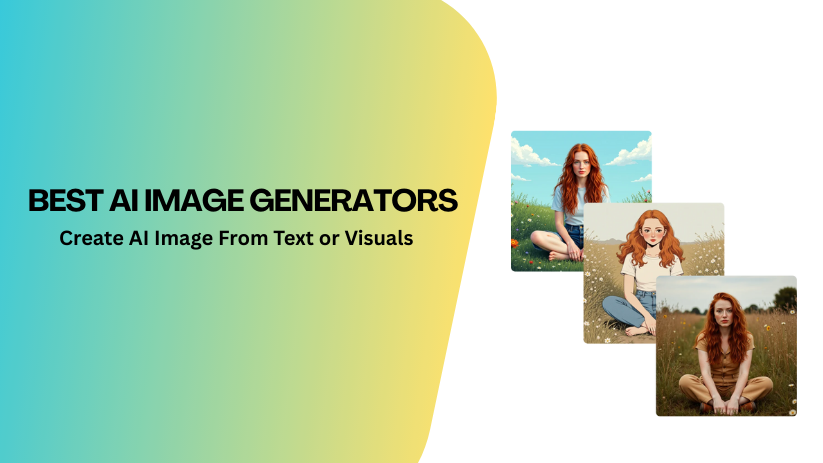
The 9 Best AI Image Generators of 2026 (Tested Firsthand)
Image generators have been gaining attention rapidly in recent years. Whether on social media, in news shows, or in magazines, computer-generated visuals are everywhere, sometimes without people even realizing it. These tools are useful for artists, designers, marketers, programmers, and everyday users. They make creating marketing images, logos, brand visuals, and artistic designs faster and easier.
For freelancers, image generators save time. Businesses can produce corporate visuals without a designer. Social media managers can create engaging posts quickly. Writers, streamers, and game developers can bring almost any idea to life. Today, these tools are powerful and versatile enough for almost any creative need.
This blog will explain how image generators work, why they are valuable, and which is the best AI image generators 2026 platforms stand out. If you are looking for the best tools for professional use, this guide will help you make an informed choice.
What is an Image Generator Tool?
An image generator is a software platform that creates visuals from text, style, or reference images using advanced computer models. These tools are trained on large collections of images and can understand composition, textures, lighting, and styles. Modern image generators go beyond basic visuals. They can produce realistic scenes, illustrations, branding assets, and concept art in seconds.
For businesses, the value is speed and flexibility. Teams can quickly visualize ideas, test concepts, and iterate without long design cycles. Many tools offer control over styles, consistency, and licensing for commercial use, making them suitable for real-world projects.
In 2026, image generators are production-grade tools. They support marketing campaigns, user interface design, e-commerce catalogues, and even architectural visualization at scale.
How Do AI Image Creators Work?
Most modern AI image generators rely on diffusion models, with some legacy influence from Generative Adversarial Networks (GANs).
In simple terms, diffusion models learn how to reverse noise. They start with visual static and gradually refine it into a coherent image based on your text prompt. When you type something like “a futuristic city at sunset”, the model breaks that input into semantic concepts such as environment, lighting, mood, color, and structure.
- High-quality generators stand out because they:
- Interpret prompts accurately rather than hallucinating details
- Maintain consistent style across multiple generations
- Apply realistic lighting, shadows, and materials
- Respect spatial logic and anatomy
The best AI tools to generate images are trained on photos, illustrations, 3D renders, and design assets, which allows them to produce visuals that feel intentional instead of random. If the output looks cinematic, balanced, and believable, that is not luck. That is model maturity.
How to Use AI Image Generation at Work?
Professionals across industries are rapidly adopting AI image generators to streamline creative workflows. Here’s how they’re being used in real-world scenarios:
Creating thumbnails for blogs and articles
Content creators can generate custom visuals instead of relying on generic stock photos.
Designing social media posts
Marketers use AI image generators to produce engaging visuals quickly, enabling faster content cycles.
Drafting presentation visuals
Teams can instantly visualize ideas during brainstorming and early design discussions.
Personalized customer engagement
Businesses generate tailored visuals for targeted ads, promotions, and email campaigns.
For writers, designers, startups, and small businesses, AI image generators significantly reduce costs while improving creative speed and flexibility.
9 Best AI Image Generator Tools (Quick Overview)
| Tool | Best For | Key Feature | Image Quality | Access Options |
| Midjourney | Artistic and cinematic visuals | Exceptional style depth | Excellent | Discord |
| DALL·E | Prompt accuracy and clarity | Strong concept interpretation | Very Good | Web via ChatGPT |
| Adobe Firefly | Commercial-safe design | Licensed training data | Very Good | Adobe Creative Cloud |
| Stable Diffusion | Custom workflows | Open ecosystem | Variable to Excellent | Local and Cloud |
| Leonardo AI | Game and product visuals | Asset-focused generation | Excellent | Web |
| Ideogram | Text-integrated images | Clean typography | Good | Web |
| Playground AI | Beginner workflows | Simple UI | Good | Web |
| Runway | Media production | Image and video synergy | Very Good | Web |
| Canva AI | Business visuals | Speed and templates | Good | Web |
Each of these tools serves a different purpose. Pretending there is one universal best option is amateur thinking.
1. Midjourney
Midjourney is widely regarded as the most artistically sophisticated AI image generator available today. It specializes in producing cinematic, stylized, and emotionally rich visuals that closely resemble high-end digital art. Rather than focusing on strict realism or workflow automation, Midjourney prioritizes aesthetic impact and creative expression.
Why It’s Great
- Exceptional artistic quality: Consistently produces visually striking, gallery-level images
- Strong aesthetic coherence: Styles remain consistent across variations
- Rich style diversity: Excels at cinematic, painterly, fantasy, and surreal visuals
- Large creative community: Extensive prompt sharing and experimentation
Drawbacks
- Discord-based workflow: No traditional web interface, which can feel unintuitive
- Prompt learning curve: Advanced results require understanding Midjourney syntax
- Limited editing tools: Minimal inpainting or fine-grain control compared to competitors
- Not workflow-focused: Lacks integrations for scheduling or asset pipelines
Pricing
- Basic: $10/month (limited fast generations)
- Standard: $30/month (unlimited relaxed generations, fast-hour allowance)
- Pro: $60/month (more fast hours, stealth/private mode)
Best For
- Digital artists and illustrators
- Creative agencies
- Marketing teams producing high-impact visuals
- Anyone prioritizing artistic quality over automation
2. DALL·E
DALL·E is best known for its ability to accurately translate text prompts into clear, coherent images. It focuses on prompt understanding, logical composition, and object placement rather than heavy stylization. Integrated into ChatGPT, it’s one of the most accessible AI image generators for both beginners and professionals.
Why It’s Great
- Excellent prompt adherence: Interprets complex descriptions with high accuracy
- Concept clarity: Strong at visualizing abstract or narrative ideas
- Built-in editing tools: Inpainting, outpainting, and variations are easy to use
- Beginner-friendly interface: No technical knowledge required
Drawbacks
- Less artistic flair: Images are clean but can feel less dramatic than Midjourney
- Style control is limited: Fewer creative tuning options
- Usage limits: Heavy users may encounter rate limits
- Dependent on ChatGPT interface: Less standalone creative tooling
Pricing
- Free: Limited access via ChatGPT
- ChatGPT Plus: $20/month (higher usage limits)
- Team plans: Higher limits and collaboration features
Best For
- Content creators and writers
- Educators and students
- Non-designers needing accurate visuals
- Teams already using ChatGPT
3. Adobe Firefly
Adobe Firefly is a professional AI image generator designed specifically for commercial-safe creative work. Trained on licensed and public-domain content, it integrates deeply with Adobe Creative Cloud applications. Firefly emphasizes reliability, brand safety, and seamless incorporation into existing design workflows.
Why It’s Great
- Commercially safe outputs: Designed for business and enterprise use
- Native Adobe integration: Works directly inside Photoshop, Illustrator, and Express
- Reference-based generation: Use existing brand assets to guide results
- Consistent, polished quality: Ideal for marketing and print work
Drawbacks
- Less experimental: Prioritizes realism and polish over artistic risk
- Slower iterations: Compared to lightweight web tools
- Adobe ecosystem dependency: Best value requires Creative Cloud
- Credit-based usage: Limits apply outside full subscriptions
Pricing
- Free: Limited monthly generative credits
- Firefly Standard: ~$4.99/month (web-based access)
- Creative Cloud: ~$59.99/month (full access within Adobe apps)
Best For
- Professional graphic designers
- Branding and marketing teams
- Advertising agencies
- Enterprises with legal and compliance requirements
4. Stable Diffusion
Stable Diffusion is a powerful open-source AI image generator that offers unmatched flexibility and customization. Unlike closed platforms, it allows users to run models locally, fine-tune outputs, and fully control the generation pipeline. This makes it a favorite among developers, technical artists, and advanced creators who value freedom over convenience.
Why It’s Great
- Open-source freedom: Modify models, prompts, and workflows without platform restrictions
- Deep customization: Supports custom checkpoints, LoRAs, ControlNet, and extensions
- Local or cloud deployment: Run offline for privacy or scale via hosted GPU services
- Massive community ecosystem: Thousands of community-trained models and tools
Drawbacks
- High technical barrier: Setup and optimization require time and technical knowledge
- Hardware demands: Fast local generation needs a capable GPU
- Inconsistent quality out of the box: Requires prompt tuning and model selection
- Fragmented experience: No single “official” interface or workflow
Pricing
- Free: Open-source (local installation)
- DreamStudio: ~$10 for 1,000 credits (official hosted option)
Best For
- Developers and ML engineers
- Advanced digital artists
- Researchers training custom styles
- Creators needing full control and privacy
5. Leonardo AI
Leonardo AI is a creator-focused platform optimized for producing high-quality visual assets, especially for games, products, and concept art. It combines strong default models with asset-centric tools, making it easier to maintain style consistency across multiple generations. Leonardo balances creative power with usability better than most mid-tier platforms.
Why It’s Great
- Asset-focused generation: Ideal for characters, environments, props, and textures
- Style consistency: Maintain visual cohesion across large batches
- Custom model training: Train models on your own datasets
- Alchemy tools: High-quality refinement, upscaling, and detail enhancement
Drawbacks
- Token-based limits: Intensive workflows consume credits quickly
- Web-only platform: No local or offline usage
- Style bias: Outputs often lean toward game-art aesthetics
- Queue delays on free tier: Priority access requires paid plans
Pricing
- Free: 150 tokens/day
- Apprentice: $10/month (8,500 tokens)
- Artisan: $24/month (25,000 tokens)
- Maestro: $48/month (60,000 tokens, priority access)
Best For
- Game developers and indie studios
- Concept artists
- Product visualization teams
- Creators building repeatable visual systems
6. Ideogram
Ideogram is a specialized AI image generator best known for its exceptional ability to render accurate, readable text inside images. This makes it uniquely effective for logos, posters, signage, and branded graphics—areas where most image generators struggle. While it’s less versatile artistically, it excels in typography-driven design.
Why It’s Great
- Best-in-class text rendering: Accurate spelling, layout, and font styles
- Logo-friendly outputs: Ideal for brand marks and typography experiments
- Prompt remixing: Quickly iterate using “magic prompt” enhancements
- High-resolution results: Clean outputs suitable for print and digital use
Drawbacks
- Limited artistic range: Not ideal for complex scenes or photorealism
- Text-first focus: Less control for non-typographic visuals
- No image-to-image: Prompt-only generation
- Free-tier wait times: Slower queues during peak usage
Pricing
- Free: Limited daily generations (slow queue)
- Plus: ~$7/month (priority generations)
- Pro: ~$20/month (higher limits, API access)
Best For
- Logo and brand designers
- Social media and ad creatives
- Print and signage professionals
Anyone needing reliable text-in-image output
7. Playground AI
Playground AI is an accessible AI image generation platform designed for quick experimentation and everyday creative work. It supports multiple popular models, including Stable Diffusion variants, and wraps them in a simple, browser-based interface. While it’s not built for enterprise pipelines or deep customization, it’s a strong option for rapid ideation and casual production.
Why It’s Great
- Beginner-friendly interface: Clean canvas with real-time previews
- Multiple model support: Switch between SDXL and fine-tuned community models
- Fast iteration: Generate, remix, and adjust images quickly
- Generous free tier: Suitable for causal and exploratory use
Drawbacks
- Watermarks on free plan: Clean exports require a paid subscription
- Limited advanced controls: Not ideal for technical or precision workflows
- Cloud-only: No offline or local execution
- Occasional performance issues: Queue delays during peak times
Pricing
- Free: Daily image limits with watermark
- Pro: ~$15/month (no watermark, higher limits)
- Advanced: ~$35/month (priority generation, private images)
Best For
- Students and hobbyists
- Small businesses and solopreneurs
- Social media creators
- Rapid concept testing
8. Runway
Runway is a professional creative AI platform that combines image generation with advanced video, motion, and media-editing tools. It’s designed primarily for filmmakers, studios, and content teams working with motion visuals. While image generation is strong, Runway truly shines when images are part of a broader multimedia workflow.
Why It’s Great
- Text-to-video and image-to-video: Industry-leading motion generation
- Advanced editing tools: Inpainting, motion brush, background removal
- Cinematic quality: High-end visuals suitable for commercial projects
- API and collaboration: Scales well for teams and production environments
Drawbacks
- Overkill for images alone: Pricing is driven by video features
- Credit-heavy usage: Complex generations consume credits quickly
- Learning curve: Built for professionals, not beginners
- Less stylistic freedom: Compared to art-focused tools like Midjourney
Pricing
- Free: Limited credits for testing
- Standard: ~$15/user/month (monthly credit allowance)
- Pro: ~$35/user/month (higher limits, advanced features)
Best For
- Filmmakers and video editors
- Creative agencies
- Motion designers
- AR, VR, and immersive media teams
9. Canva AI Image Generator (Magic Studio)
Canva’s AI Image Generator is built for speed, simplicity, and non-designers. Integrated directly into Canva’s Magic Studio, it allows users to create images that instantly fit into presentations, social posts, and marketing materials. While it lacks advanced artistic control, it excels at fast, practical visual creation.
Why It’s Great
- Native Canva integration: Generate and edit images without leaving the platform
- Extremely easy to use: Natural-language prompts, no technical knowledge needed
- Template synergy: Works seamlessly with Canva’s design library
- Fast output: Ideal for tight deadlines and everyday content
Drawbacks
- Limited creative depth: Not suitable for complex or high-end artwork
- Canva-dependent: Best results stay within Canva’s ecosystem
- Style constraints: Fewer customization options than dedicated generators
- Usage limits: Advanced AI tools require Pro plans
Pricing
- Free: Basic AI image generation included
- Canva Pro: ~$15/month (advanced AI tools and exports)
- Canva Teams: ~$30/month (collaboration and admin controls)
Best For
- Marketers and small business owners
- Teachers and educators
- Non-designers creating visuals quickly
- Presentations, social media, and pitch decks
How to Use AI to Create Images? Step-by-Step: Guide
With modern AI image generators, strong prompts and clear visual intent replace the need for design skills. Here are the easy steps to create an AI image for people who don’t know how to do it:
Step 1: Select Your AI Image Generator
Begin by choosing the AI image generator that best fits your goal. Different tools are optimized for different creative needs:
- Artistic and cinematic visuals: Midjourney
- Photorealistic or concept-based images: DALL·E or Reve
- Text-heavy designs, logos, and posters: Ideogram
- All-purpose, beginner-friendly designs: Canva AI Image Generator
Selecting the right platform ensures better results with less effort.
Step 2: Write a Clear and Detailed Prompt
In the prompt input field, describe exactly what you want the AI to generate. The more precise your description, the closer the output will be to your vision.
Example prompt:
“A cozy coffee shop with wooden tables, warm lighting, and a cup of coffee on the counter.”
Include details about the environment, mood, lighting, colors, and style whenever possible.
Step 3: Choose Style Options (If Available)
Many advanced AI image generators allow you to customize the output before generation. Depending on the tool, you may be able to select:
- Art style (realistic, illustration, 3D, watercolor, etc.)
- Image resolution and aspect ratio
- Color palette or mood
- Lighting style or depth
Tools like Adobe Firefly or Recraft are especially useful for fine-tuning these visual parameters.
Step 4: Generate the Image
Once everything is set, click the “Generate” button or press enter. The AI will analyze your prompt and create one or multiple image variations based on your input. This usually takes only a few seconds. If the result isn’t perfect, you can tweak the prompt or settings and generate again.
Step 5: Download or Edit the Final Output
After generating the image, you can:
- Download it directly
- Adjust the crop or size
- Refine styles or regenerate variations
- Use built-in editing tools (if available)
Once finalized, your image is ready for use in blogs, social media, presentations, marketing materials, or creative projects.
AI Image Generator Safety and Ethics
AI image generators are powerful, but that power comes with responsibility. Using them carelessly can harm your credibility, break laws, or mislead people.
Copyright and Commercial Use
Not all AI-generated images are safe to use for business. Some models have unclear licenses or include copyrighted material. Always check usage rights before using images in ads, products, or client work.
Deepfakes and Misuse of Identity
AI can create realistic images of real people. Using these images to mislead, impersonate, or harm someone is unethical and can be illegal. If an image could deceive viewers, the creator is responsible.
Misinformation
AI images can look real enough to mislead people. In journalism, education, or public communication, always provide context and disclose that the image is AI-generated.
Bias in AI
AI learns from the data it is trained on. If the data has bias, the images may reflect stereotypes or limited diversity. Always review outputs carefully and avoid reinforcing harmful biases.
Responsible Use
Use AI images responsibly by understanding licensing, avoiding deception, disclosing synthetic content, and checking for bias. Ethical use is about intent and accountability.
Tips for Writing Better AI Image Prompts
AI image generators only do what you tell them. They do not read your mind. If your images look off, blurry, or uninteresting, the problem is usually the prompt. Clear and simple instructions are the key to getting great results. Here is how to write better prompts.
Start with the subject
Always say what the image is about before adding style. For example, write “A small coffee shop with a cup on the counter” instead of “A cozy illustration.”
Add context
Describe where the subject is, what is around it, the time of day, or the weather. Context makes images feel more natural.
Set mood and lighting
Use words like soft lighting, sunset, or foggy to make the image feel real and atmospheric.
Specify style
Be clear if you want the image to be photorealistic, an illustration, 3D, or cartoon.
Use meaningful adjectives
Say close-up or wide-angle instead of vague words like beautiful or cool.
Keep it short
Focus on the most important details. Long, complex prompts can confuse the AI.
Adjust step by step
If the image is not perfect, change one element at a time to see what works.
Learn from mistakes
If something looks wrong, simplify the scene or clarify your prompt. Every imperfect image is a chance to improve.
Conclusion
AI image generators are everywhere and getting more powerful. Different tools vary in cost, image quality, prompt understanding, and editing features.
Top options include DALL·E for accurate prompts, Midjourney for realistic and beautiful visuals, and Stable Diffusion for full control over the image creation process. Each has its strengths and weaknesses.
No matter which tool you use, be careful, especially for commercial purposes. Copyright, ethics, and prompt mistakes can create problems. AI can be a great helper, but it must be used responsibly.
FAQs About AI Image Generators
What is an AI image generator?
It is a tool that creates images from text prompts, styles, or reference visuals using trained AI models.
Why use AI image generators in business?
They speed up visual creation, reduce design cycles, and provide flexible options for marketing, branding, and content production.
Which tool is best for artistic visuals?
Midjourney is ideal for rich, dramatic, and creative images, perfect for branding or campaigns.
Which tool interprets prompts most accurately?
DALL·E excels at turning detailed text into clear, conceptually accurate visuals.
Why choose Adobe Firefly for enterprise work?
Firefly uses licensed training data and integrates with Creative Cloud, lowering legal risk and improving workflow.
Why use Canva’s AI image generator?
Canva is fast, easy to use, and comes with built-in templates for everyday business visuals.
Are commercial usage rights supported?
Many tools provide clear commercial licenses, but always verify terms before using images commercially.
Do AI image tools replace designers?
No, they enhance design workflows by speeding up iterations but do not replace skilled designers.
Can these tools scale for enterprise use?
Yes, with proper integration, governance, and workflow alignment, they can support large teams effectively.
